· Playbook · 5 min read
Legal video storytelling: why settlement videos win
Plaintiff attorneys are settling cases with 60-minute documentaries instead of demand letters. Emmy-nominated journalist Joe Douglass explains why the format works.
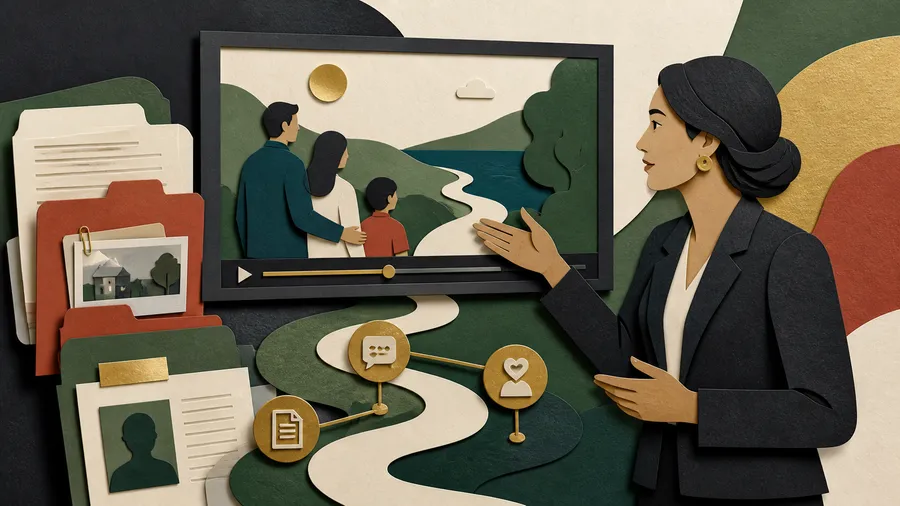
A civil case can run to tens of thousands of pages and still fail to communicate what happened to a person. The facts may all be there, but the human story is buried across medical records, testimony, reports, and exhibits. Joe Douglass has built a company around solving that problem. He is a three-time Emmy-nominated investigative journalist and the founder of Clear Eyed Media, where he produces settlement documentaries for plaintiff attorneys in civil litigation.
Before founding the company, Joe spent more than 16 years as a TV news producer and reporter in Los Angeles and Portland. That background taught him how to find a clear story inside a large, complicated body of evidence. On episode one of The Connector’s Table, he explained why that skill can change the course of an injury or neglect case before it reaches trial.
What is a settlement documentary?
A settlement documentary is a 60-minute film built from the facts and people inside a civil case, made to surface its emotional and factual power before trial. Clear Eyed Media creates these documentaries for plaintiff attorneys, usually in injury or neglect cases, so mediators and defense teams can see the case as a coherent human story rather than a stack of separate documents.
The format does not replace the evidence. It gives the evidence a shape, connecting what happened, how a person’s life changed, and what that change looks like now.
Joe is direct about the results he has seen. As he said in the conversation, “Every video I’ve made has resulted in a settlement, a substantial settlement for my clients.” That is his claim, based on his own client work, and it explains why the format has become much more than a polished presentation.
Why does video move a case when case files don’t?
Video can move a case because seeing a victim’s real life is more persuasive than reading about it, and the mediators and defense teams evaluating a case are human. A written record can establish what happened. A documentary can show what those facts mean in the routines, relationships, and limitations of an actual person.
That difference matters when a case has become abstract. After thousands of pages, it is easy for the person at the centre of the case to disappear behind dates, procedures, and arguments. Legal video storytelling restores that person without changing the underlying facts. A face, a voice, and an ordinary day can make consequences legible in a way a summary cannot.
The power is not spectacle. It is recognition. The viewer sees the life attached to the claim, which gives the factual record emotional context before the parties decide whether to proceed to trial.
What are the rules for day-in-the-life legal videos?
Day-in-the-life legal videos must follow strict rules of admissibility because everything captured in the raw footage could end up in front of a jury. That makes honesty and protocol more important than polish. The goal is not to manufacture a dramatic scene. It is to document a person’s real circumstances faithfully enough that the footage can withstand scrutiny.
In a legal setting, every choice has consequences beyond presentation. The raw material itself matters, not only the finished cut.
This is why the journalist’s discipline fits the work. Careful observation, accurate representation, and respect for the record are not creative preferences here. They are the conditions that make the story useful.
How do you find the story in 40,000 pages?
You find the story in 40,000 pages by identifying the through line and having the discipline to leave out everything that weakens it. Joe has worked through case files of that size, and he describes the hardest editorial decision as deciding what does not belong. A tangent may be true and interesting, yet cutting it can produce a more powerful story.
That is an investigative journalism instinct. The job is not to repeat every available fact. It is to understand the material deeply enough to recognize which facts explain the case and which ones pull attention away from it. More information does not by itself create more clarity.
The editing is part of the reasoning. The result is not a thinner version of the case. It is a clearer one, with the facts arranged so the audience can follow their meaning.
What does this teach B2B founders about storytelling?
It teaches B2B founders that valuable expertise often surfaces in conversation, not in brochures. Joe’s distinction between a complete record and a clear story is the kind of insight that becomes visible when someone has room to explain how they actually work. This article exists because he sat down for a podcast conversation and followed the idea far enough to make it useful.
That is also why a good B2B show can do more than fill a content calendar. The full conversation with Joe gives his expertise a stage, while the ideas inside it can keep travelling in formats built for different audiences. The same conversation can also begin a real business relationship when the follow up is handled thoughtfully, which is the point behind turning podcast guests into clients.
If your best ideas tend to appear in conversation, book a call and we will help you build a show that gives those ideas somewhere to go.