Businesses comparing lead or appointment generation
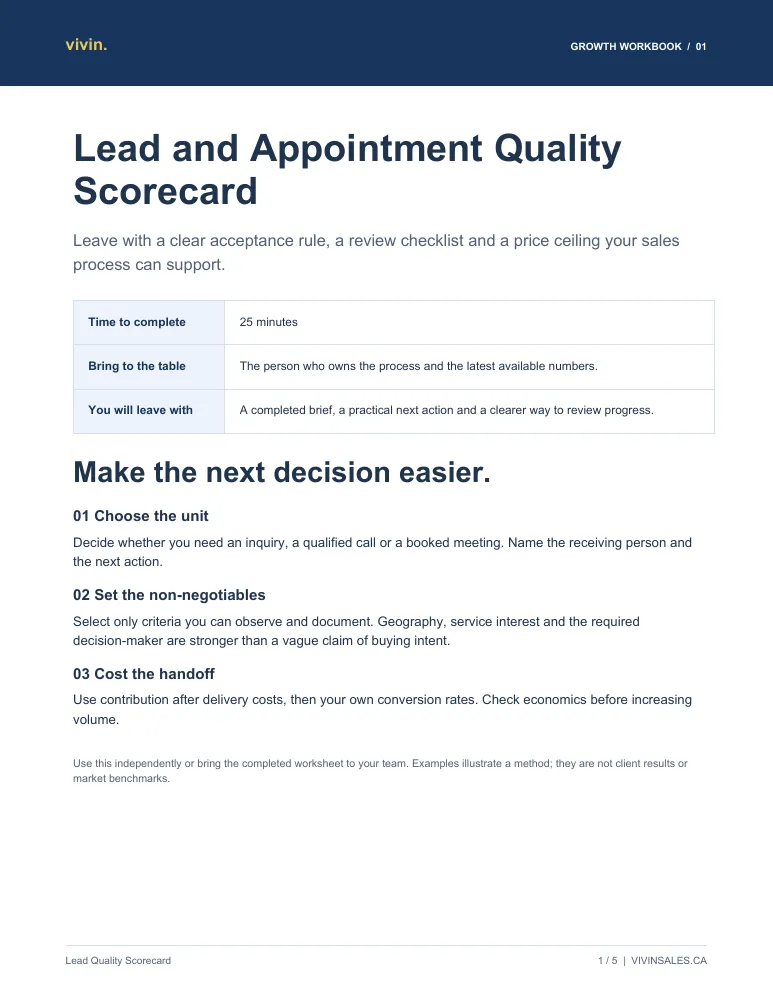
Lead and Appointment Quality Scorecard
Define what counts, review delivery consistently, and keep leads, bookings, held meetings, and sales outcomes separate.
Use this worksheet before buying leads or booked appointments. Agree on what counts, then use the same definition when reviewing delivery. A researched contact, an interested lead, a booked appointment and a completed meeting are different outcomes.
1. Define the opportunity
| Decision | Your answer |
|---|---|
| Service you sell | |
| Ideal customer or household | |
| US states or Canadian provinces served | |
| Person who should participate | |
| Problem or need they should acknowledge | |
| Minimum project or customer fit, if applicable | |
| Conditions that disqualify an opportunity | |
| What you are buying: lead, qualifying call or booked appointment |
Keep required criteria observable. “Interested in discussing a roof replacement” can be documented. “Will definitely buy” cannot be known before a sales decision.
2. Review each delivered opportunity
Mark Yes, No or Needs review for each applicable item. Do not average away a failed required criterion. Any required item marked No needs review before you accept the opportunity.
| Check | Required? | Result | Evidence or note |
|---|---|---|---|
| Fits the agreed geography | |||
| Fits the agreed customer type | |||
| Has the agreed relevant need or interest | |||
| Includes usable contact details | |||
| Is not an excluded duplicate | |||
| Relevant person has agreed to the next step | |||
| Appointment time and timezone are clear, if applicable | |||
| Meeting link or call instructions are usable, if applicable | |||
| Qualification notes support the agreed criteria | |||
| Your team can respond or attend as agreed |
3. Set the review process before launch
Write down who reviews opportunities, the review window, evidence needed for a dispute and the agreed replacement conditions. Keep invalid details, poor fit, cancellations, no-shows and a valid meeting that does not close as separate categories.
Reviewer: **__** Review window: **__**
Evidence required: **__**
Replacement conditions: **__**
Client response and attendance responsibilities: **__**
4. Track the funnel without mixing stages
| Metric for one cohort | Count |
|---|---|
| Delivered leads or booked appointments | |
| Accepted against the agreed criteria | |
| Appointments booked | |
| Appointments held | |
| Sales opportunities created after discussion | |
| Customers won | |
| Customer payments collected in the chosen period |
Acceptance rate = accepted opportunities ÷ reviewed opportunities.
Show rate = held appointments ÷ appointments due to occur, excluding future bookings and documented reschedules to a future date.
Close rate = customers won ÷ held sales appointments in the same tracked cohort. Allow enough time for the sales cycle before comparing cohorts.
If a denominator is zero, record “not available” rather than 0%.
5. Check your economics
Estimated contribution per new customer = collected customer revenue minus direct costs of serving that customer, before acquisition expense.
Allowable acquisition spend per customer = the portion of that contribution you are willing to spend to acquire the customer.
For a booked-appointment offer: planning ceiling per booking = allowable acquisition spend per customer × expected show rate × expected close rate from held appointments. Use your own observed rates where available. This is a planning estimate, not a forecast or a recommended purchase price.
Your allowable acquisition spend: **__**
Your expected show rate: **__** Expected held-meeting close rate: **__**
Your planning ceiling per booking: **__**
Put the scorecard to work
Bring this completed worksheet to a discussion with Vivin. We can use your customer criteria and sales process to scope leads, qualifying calls or booked appointments for your business.
Next step: Discuss leads and appointments for your industry.